
The distinction that matters most
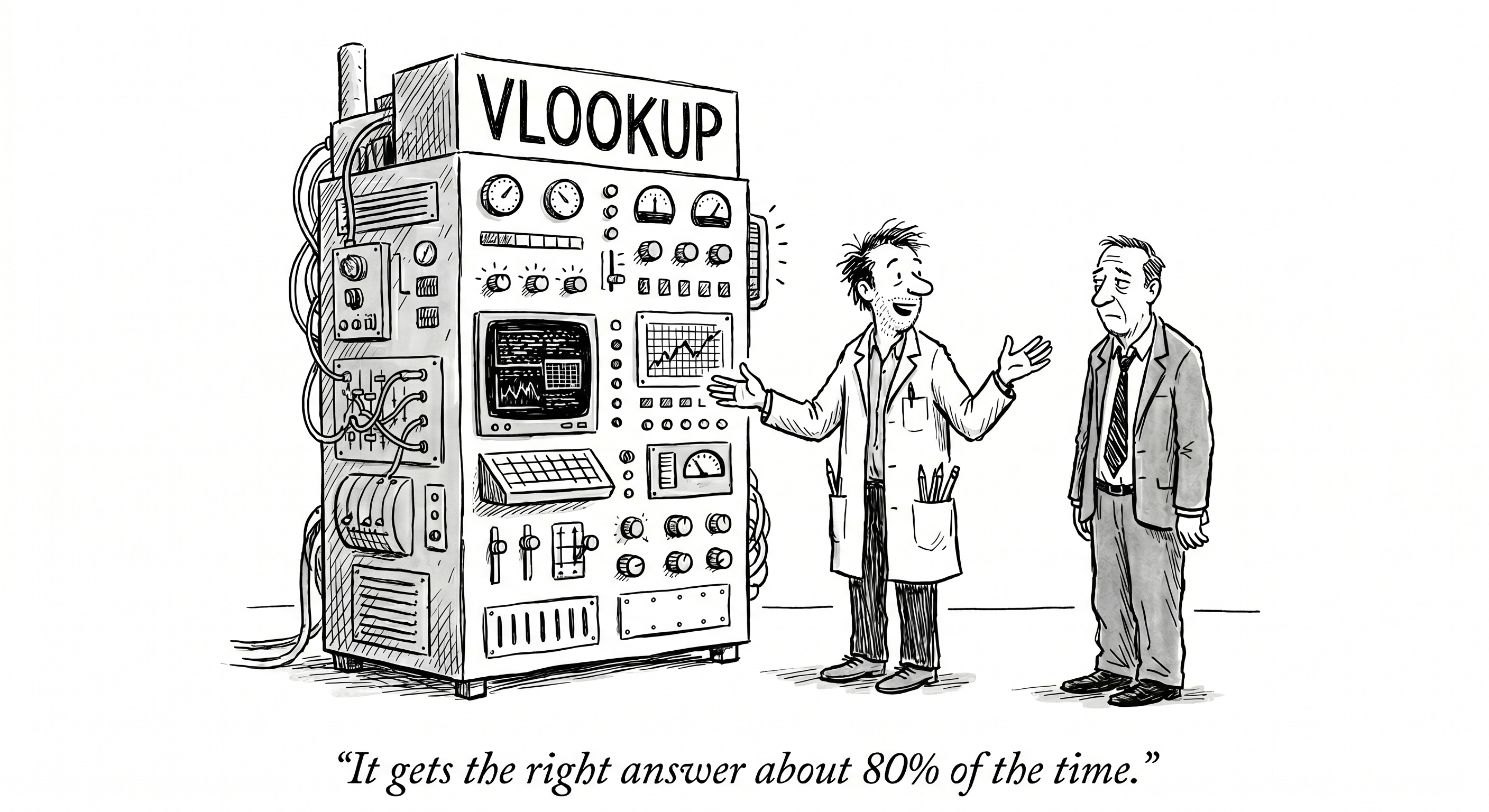
The single most useful question you can ask about any potential AI use case is this: does this task need the same answer every time, or is variation acceptable?
Traditional software is deterministic. Feed it the same inputs and it produces the same outputs, without exception. Your payroll system calculates the same withholding for the same salary. Your database returns the same records for the same query. Your spreadsheet formula gives the same total for the same numbers. That consistency is the entire point.
AI is probabilistic. It generates outputs that are likely correct and often impressively good, but ask the same question twice and you may get two different answers. Both might be reasonable. Neither will be identical. For drafting a newsletter or summarizing a long report, that variation is fine, sometimes even desirable. For calculating funder reimbursements or matching clients to eligibility criteria, it's a liability.
If the task requires the same answer every time for the same inputs, you probably need traditional software. If the task benefits from interpretation, synthesis, or judgment, AI is worth considering.
When traditional tools are the better choice
Compliance math. Grant reporting, payroll, tax withholding, eligibility determinations. These tasks have defined rules and defined inputs, and the answer is either right or wrong. A formula gets it right every time. An AI tool gets it right most of the time, which in a compliance context is the same as getting it wrong.
Structured data entry. If your staff are selecting from a fixed set of categories, a well-designed form with dropdowns and validation rules is faster and more reliable than an AI interpreting free text.
Automated workflows. "When a new donation comes in, send a receipt and update the donor record" is a job for a CRM automation, not a language model. The logic is defined, and you need it to work identically every time.
When AI is the right fit
Drafting text. Grant applications, donor communications, board reports. AI handles the blank-page problem well, and the expected output is subjective enough that variation between drafts is a feature rather than a flaw.
Summarizing and synthesizing. Turning a long report into a short one, pulling themes from program evaluations, condensing meeting notes into action items. These tasks require judgment about what matters, which is where AI performs well and where traditional tools have no answer at all.
Interpreting unstructured information. Surfacing trends from client feedback, adapting a document's reading level, translating materials. The answer is interpretive by nature, so probabilistic outputs are appropriate.
The expensive middle ground
The most costly mistake I see is using AI for a task that requires deterministic results, then adding layers of human review to compensate for the uncertainty. You end up paying for the AI tool and the staff time to verify every output. Whatever time savings the AI was supposed to provide disappears into the verification step. For more on this pattern, see the first mistake on this list.
Chaining tools together
The best results I've seen come from workflows that use each tool for the step it handles best. Your database pulls the numbers. A spreadsheet does the calculations. Then AI writes the narrative that wraps around them. Each tool does what it's good at, and the output is both accurate and well-written in a way that neither tool could achieve alone.
A funder report is a good example. The financial tables should come from your accounting system, not from AI. But the two-page program narrative that accompanies those tables, the one that synthesizes six months of work into a coherent story, is a place where AI can save your development director hours of drafting time. The trick is knowing where one tool ends and the other begins.
The question to ask about any workflow is not "can AI do this?" but "which parts of this need to be right every time, and which parts benefit from flexible language and interpretation?" Split the workflow accordingly.
How to decide
Two questions will sort most use cases. First: is the expected output objective or subjective? If there's one correct answer, lean toward traditional tools. If the output involves language, judgment, or interpretation, AI is worth considering. Second: what's the cost of being wrong? An AI-drafted paragraph that needs a word changed is a minor edit. A miscategorized grant expenditure that a funder flags in an audit is a different kind of problem. Match the tool's reliability to the stakes.
An AI readiness assessment can help sort which of your workflows belong in which category. The goal is not to maximize AI adoption. It's to match the right tool to the right problem, which sometimes means the right tool is the one you already have.
If you're trying to figure out where AI fits in your organization and where it doesn't, that's a conversation worth having before you commit to a tool. I help mission-driven organizations make those distinctions clearly.
Book a 30-minute conversation