
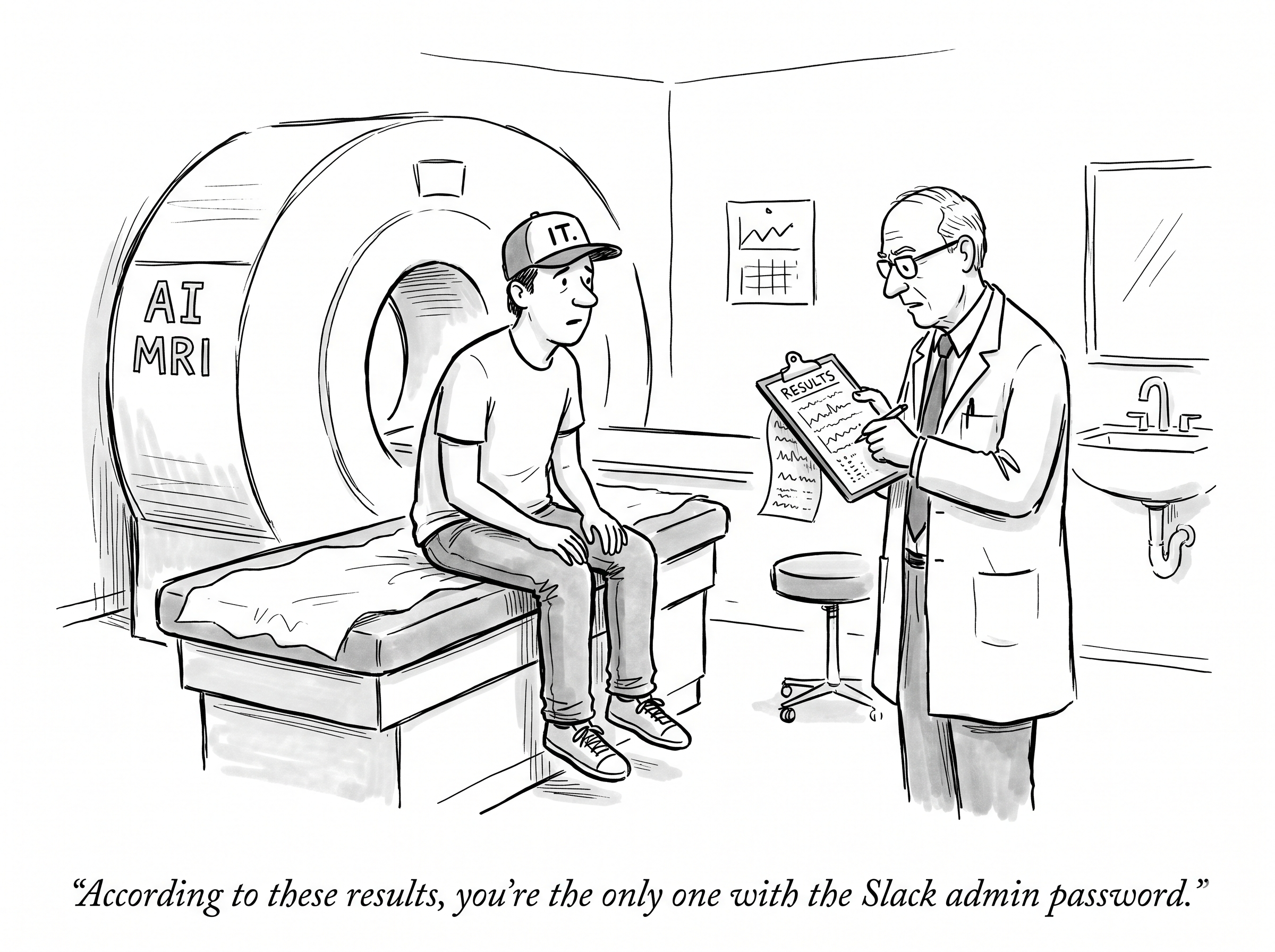
The organizational MRI
I've started thinking of AI as a kind of diagnostic scan for organizations. An MRI doesn't make you sick. It shows you what's already going on inside, including things you might have been managing around for years without realizing it.
AI does the same thing to operations. When you try to hand a task to an AI tool, you immediately discover whether that task was well-defined in the first place. You find out whether the information it depends on is accessible or locked in someone's email. You learn whether the quality standards for that work are written down anywhere, or whether they exist as instinct in the mind of the person who's been doing it for a decade.
Organizations with strong foundations tend to adopt AI faster and with fewer problems. Their workflows are already documented. Their data is organized. Their teams know who owns what. The AI slots into an infrastructure that was built to absorb new tools, because the infrastructure was built well for its own sake.
Organizations with shaky foundations discover the shakiness immediately. And that discovery, while uncomfortable, is one of the most valuable things AI can do for you.
The fragility that was already there
Mission-driven organizations are especially prone to a particular kind of structural debt, and it's worth naming directly. Many of these organizations were built in a hurry, held together by committed people working long hours, and sustained through institutional memory rather than documented systems. That approach works for a long time. It works until the person who holds the memory leaves, or the organization tries to scale, or a new tool arrives that needs clear inputs to produce useful outputs.
The patterns show up in predictable places. Core processes exist in people's heads rather than in shared documentation. When someone leaves, the knowledge walks out with them. Teams depend on the one person who knows how the database works, or how the grant reporting template is supposed to be formatted, or where the files from last year's audit are stored. Ownership of decisions is unclear, with no consistent answer to basic questions like who reviews this output, which version is authoritative, or who has final say.
None of these are AI problems. They're organizational problems that AI surfaces because AI needs clarity to function. A tool that generates a first draft of your grant report needs to know what information goes in the report, where that information lives, and what standard the draft will be measured against. If those answers don't exist in any retrievable form, the AI isn't the bottleneck. The missing infrastructure is.
What AI amplifies
There's a pattern I've seen play out enough times to describe with confidence: AI amplifies whatever already exists in an organization. It doesn't fix broken systems, and it doesn't break working ones. It accelerates both.
If your workflows are weak, AI produces confusion faster. If your data quality is poor, AI scales the inconsistency. If nobody knows who owns a decision, AI operationalizes that ambiguity by producing outputs that nobody is clearly responsible for reviewing.
The encouraging version of the same pattern is just as true. If you have a strong learning culture, AI accelerates insight. If your governance is clear, AI adoption happens more responsibly and sticks longer. The organizations that do this well tend to be the ones that were already running well before AI entered the conversation.
When early AI adoption feels chaotic, resist the instinct to blame the tool. The chaos was usually there before. The tool just gave it a faster engine.
Governance is already behind
One of the most consistent findings across every engagement I've had this year is that staff AI use is running ahead of organizational policy. People are using AI tools in their daily work right now, often without formal guidance, disclosure norms, or managerial awareness.
This isn't recklessness. Most staff using AI are doing so because they found a way to do their jobs better and faster. But the gap between what's happening in practice and what leadership knows about creates real risk, particularly when staff are making their own calls about what data is safe to put into which tools.
What's acceptable in one department is often unknown in another. Review standards, data handling practices, and approval processes vary from team to team. I worked with one organization where staff AI usage was widespread, but confidence in organizational governance around that usage was close to zero. People were experimenting productively and worrying about it at the same time, because nobody had told them what the boundaries were.
The fix is straightforward, and I've written about it before: write a policy before you need one. The organizations that establish clear, simple guidelines early give their people the confidence to use AI openly instead of quietly, which means the organization gets to learn from the experimentation instead of being surprised by it later.
People need permission before fluency
When I work with teams on AI adoption, the most common barrier isn't technical skill. People can learn to use ChatGPT or Claude in an afternoon. The barrier is psychological. Staff are uncertain about whether they're allowed to use these tools, worried about doing something wrong, anxious about what it means for their role, and sometimes embarrassed about needing help with something that feels like it should be intuitive.
The organizations that handle this well do a few things consistently. They normalize experimentation without judgment. They center peer learning over expert instruction, because people trust their colleagues' experience more than a training deck from a vendor. They reduce the fear of failure explicitly, which means leadership says out loud that trying AI and getting a bad result is fine, expected, and part of the process.
Psychological safety has become part of technology strategy, whether organizations recognize it or not. A team that's afraid to admit they tried an AI tool and it didn't work well is a team that won't share the workflow that did work well either. Both require the same willingness to be visible.
Your operational staff are your AI leaders
One of the things that keeps catching me off guard, even though it shouldn't, is where AI leadership tends to emerge in an organization. The most useful AI thinking doesn't come from the executive suite or the innovation committee. It comes from operations staff, grants managers, compliance leads, and administrative coordinators.
These are the people who understand workflow reality. They know where review processes break down, where documentation gaps create rework, and where teams are improvising because the system never quite worked as designed. They hold institutional memory. When you're trying to figure out which workflows to target first or where governance is weakest, these are the people with the answers.
Including operational staff in AI planning from the beginning, in policy drafting, vendor evaluation, and implementation design, is the difference between a strategy that maps to how work gets done and one that maps to how leadership imagines work gets done. Those are often two different things.
The infrastructure underneath
Here's a connection that isn't obvious at first: organizations that have been struggling with reporting burden tend to be the same organizations that struggle most with AI adoption. The reason is that the infrastructure for meaningful reporting and the infrastructure for meaningful AI use are the same infrastructure. Both require clean data, shared understanding, and systems designed to produce learning rather than compliance artifacts.
If your organization collects data primarily to satisfy funder requirements, and nobody synthesizes or acts on that data internally, AI won't help much. You'll end up with faster production of information nobody uses. But if your reporting systems are designed to surface insight, track what's working, and feed what you learn back into your programs, AI can amplify that loop considerably.
This is why early AI work at many organizations ends up looking a lot like operational improvement work. You start by trying to use AI for a specific task, discover that the task depends on information that isn't organized or accessible, and realize you need to fix the information problem before the AI problem. That's not a detour. That's the work.
What to do with the diagnosis
If AI is functioning as a diagnostic, the question is what you do with what it reveals. A few starting points that I've seen work well in the first 30 to 90 days:
Map what's already happening. Before you plan anything new, find out where AI is already being used across your teams. You'll probably be surprised by both the breadth and the thoughtfulness of what staff are doing on their own.
Pick one fragile workflow and document it. Choose a process that depends on one person's knowledge or has unclear ownership, and write it down. Not as an AI project, but as an organizational health project that will make AI adoption easier later.
Close one governance gap. Identify a decision area where nobody is sure who has authority, and assign clear ownership. This could be as specific as who reviews AI-generated content before it goes to funders, or as broad as who approves new tool purchases.
Create one safe place to learn. Set up a low-stakes environment where staff can experiment with AI without worrying about getting it wrong. A monthly sharing session, a Slack channel for tips, a standing offer to try AI on a task that doesn't have high consequences if the output isn't great.
None of these require a large budget or a consultant. They require someone deciding that the organizational fragility AI is surfacing deserves attention rather than avoidance.
The organizations that treat early AI friction as useful data about their own operations, rather than evidence that AI doesn't work for them, end up in a much stronger position. Not just for AI adoption, but for everything else their teams need to do well.
If AI adoption is surfacing operational questions you weren't expecting, that's a sign you're paying attention. I help mission-driven organizations turn that diagnostic information into a practical plan.
Book a 30-minute conversation